
Annapoorna chain of restaurants owner Srinivasan is seen purportedly highlighting concerns over varying GST rates. In the second video, Srinivasan was seen purportedly apologising in person to the Finance Minister.

The GST bill was earlier planned to be introduced from April 1.

Some also demanded empowering of local bodies.

For every rupee in the government coffer, the biggest pie of 66 paise will come from direct and indirect taxes, according to the Union Budget 2025-26 documents. Around 24 paise will come from borrowings and other liabilities, 9 paise from non-tax revenue like divestment, and 1 paise from non-debt capital receipts, the Budget documents said.
India's opposition parties have sharply criticized the Union Budget, calling it inadequate to address the country's economic woes and accusing the BJP-led government of using it to woo voters in Bihar and Delhi ahead of upcoming elections. Leaders from the Congress, TMC, DMK, SP, and CPI(M) voiced their disapproval, highlighting concerns over inflation, unemployment, and the lack of substantial measures to support the agricultural sector and the poor. They also criticized the tax cuts for the middle class as insufficient and coming too late after years of high taxes and rising prices.

Claiming taxes collected from the south were being distributed to north India and that the former were not getting their due share, Congress MP D K Suresh on Thursday said the southern states will be forced to demand for a separate nation if the 'injustice' was not rectified.

As the Indian stock markets tumble under the panic set off by US President Donald Trump's tariff tantrums, three market experts weigh in on the reasons behind this fall, how much pain is left and how should investors adapt their strategies to invest in markets.

Hero MotoCorp anticipates a big rebound in two-wheeler (2W) sales in rural India over the next four to eight quarters, driven by favourable factors such as a decent monsoon, rising crop prices, improved employment conditions, and increasing consumer confidence, its chief executive officer (CEO) Niranjan Gupta said on Wednesday. Amid tepid rural sales, he stated that there is a "strong case" for GST (goods and services tax) on entry-level two-wheelers, which are under 125 CC, to be moved down from 28 per cent to 18 per cent as they are used by "masses".

'Otherwise, how is the government going to make more revenue?' 'The most important thing the GST does is to transfer money from the household consumers who are the most productive users of capital to the most unproductive users of capital, namely the government.'

They've proposed a sub-committee under the proposed GST Council or the Empowered Committee of State Finance Ministers to resolve any disputes in the tax's implementation.

'So far, the government has sanctioned more than Rs 300 billion as GST refunds,' Ansh Bhargava and Aditya Singhania point out.
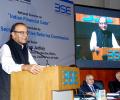
The government has proposed to implement GST from April 1, 2016, and the new Finance Commission may be set up ahead of its schedule to look into the issues related to the new indirect tax regime.

It will also be new Revenue Secretary Sanjay Malhotra's first GST Council meeting. He will take charge after the incumbent Tarun Bajaj retires on November 30.
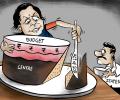
Kerala Finance Minister KN Balagopal on Friday urged the Centre to provide more fiscal powers to the states as well as increase the shareable proportion of the GST collections. Besides, he asked the central government to expedite approval for the semi-high-speed railway line or the Silverline project from Thiruvananthapuram to Kasargod. The project is mired in controversies.

The Centre has recovered around Rs 95.86 crore from at least 11 crypto exchanges for evading goods and services tax (GST), according to data released by Parliament on Monday. The amount includes interest and penalty. The GST investigation department has detected a total tax evasion of Rs 81.54 crore by crypto exchanges that include WazirX, Coin DCX, CoinSwitch Kuber, Buy Ucoin, UnoCoin and Flitpay, among other exchanges. In a written reply to Lok Sabha, minister of state (MoS) for finance Pankaj Chaudhary said 11 cases of GST evasion by cryptocurrency exchanges have been detected by central GST formations.

The finance ministry has said that the Goods and Services Tax will not apply on room rents of 'sarais' (inns) or properties managed by religious and charitable institutions. The clarification was issued by the Central Board of Indirect Taxes and Customs (CBIC) on Thursday evening to clear the confusion with regard to the levy of GST on room rents. This clarification by the Finance Ministry came following a demand from various quarters including AAP MP Raghav Chadha that the GST on rooms rented by religious institutions be withdrawn.

GSTN said those who do not want to give their Aadhaar numbers would have to undergo physical verification.

The states which achieved "extraordinary growth" in total taxes collected include Kerala (44 per cent), Jharkhand (20 per cent), Rajasthan (14 per cent), Uttarakhand (13 per cent) and Maharashtra (11 per cent), an official statement said.

The victory of the Congress and its allies in three out of five states may make it easier for the United Progressive Alliance government to move forward on the Goods and Services Tax.
Bharatiya Janata Party on Thursday issued a three-line whip to all of its Lok Sabha MPs asking them to be present in the House for the passing of the Union Budget 2025-26.

After securing Congress support for a rise in the foreign investment cap in the insurance Bill, this is another key reform Bill where the Centre has managed a broad consensus.

Some of his directives had the Supreme Court judges disclose their assets whereas the row over the discovery of cash from a sitting judge's official residence paved way for inquiry.

Businesses across the country may soon be required to issue electronic invoices, or e-invoices, directly to consumers for the sale of goods and services. The Goods and Services Tax (GST) Council, in its forthcoming meeting on Monday, is expected to discuss extending the e-invoicing mandate to cover business-to-consumer (B2C) transactions. Currently, e-invoicing is compulsory for businesses with a turnover of Rs 5 crore and above, but only for their business-to-business (B2B) transactions.

'The low tax to GDP ratio of the country will go up, helping the government to adhere to fiscal discipline and keep inflation in check.'

In a development that may encourage increased investment in commercial real estate, the Supreme Court on Thursday gave the industry relief by permitting input tax credit (ITC) on construction expenses for buildings meant to be leased. "If the construction of a building was essential for carrying out the activity of supplying services, such as renting or giving on lease or other transactions in respect of the building or a part thereof, which are covered by clauses (2) and (5) of Schedule II of the CGST (Central Goods and Services Tax) Act, the building could be held to be a plant," said Justice Abhay S Oka and Justice Sanjay Karol.

Lack of visibility on rates makes companies apprehensive.

Nasscom president said moving from single to multiple points could be a challenge from the point of view of ease of doing business

As the Union Budget 2025-2026 (FY26) inches closer, the Indian real estate industry is seeking stamp duty cuts, revised home loan limits and updated affordable housing norms through Pradhan Mantri Awas Yojna (PMAY), single-window clearance and eco-friendly policies, among others. Industry leaders and consultancy firms, including Anarock, Raheja, Gaurs, Kanodia Group, Reach, Urban Space, Justo and Eros Group, have shared their expectations.

GST, which will replace almost all central and state taxes, could have two components of 8 per cent each -- one will go to the Centre and the other to the states, according to sources familiar with the talks between the Centre and the states. However, it will not cover tax on petroleum products and Customs duty.
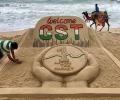
The collections from Goods and Services Tax (GST) grew by 15 per cent to over Rs 1.49 lakh crore in December 2022, indicating improved manufacturing output and consumption demand, besides better compliance. This is the 10th month in a row that the revenues have remained above the Rs 1.4 lakh crore mark. The collection in November was about Rs 1.46 lakh crore. "The gross GST revenue collected during December 2022 is Rs 1,49,507 crore, of which CGST is Rs 26,711 crore, SGST is Rs 33,357 crore, IGST is Rs 78,434 crore (including Rs 40,263 crore collected on import of goods) and cess is Rs 11,005 crore (including Rs 850 crore collected on import of goods)," the ministry said in a statement.
Mop up grows 10% y-o-y at Rs 1.05 trillion, almost equal to levels in February before a nationwide lockdown to contain the coronavirus pandemic

'If petro products are brought into GST, then there will be minor impact on the incidence of tax... and minor impact on prices. The price of petrol, diesel will continue to be driven by global factors'
The United Progressive Alliance government in 2011 introduced a Constitution Amendment Bill in the Lok Sabha to pave the way for the GST regime which aims at subsuming most of the indirect taxes at the central as well as the state levels.

Sri Annapoorna Hotel on Saturday appealed to the people to put to rest unnecessary assumptions and political misunderstanding after a video of its owner apologising to Union Finance Minister Nirmala Sitharaman over his remarks on Goods and Services Tax (GST) went viral on September 13.
The Centre and the state governments have agreed not to unilaterally change the tax rate on goods and services, once the Goods and Services Tax (GST) is implemented from April 2010.
All GST anti-profiteering complaints would be dealt with by the Competition Commission of India (CCI) from December 1 as the extended tenure of National Anti-profiteering Authority ends this month, an official said on Tuesday. A notification in this regard is expected to be issued by the finance ministry later this month, the official added. The National Anti-profiteering Authority (NAA) was set up in November 2017 under Section 171A of Goods and Services Tax (GST) law to check unfair profiteering activities by registered suppliers.

Finance ministry sources have countered CAG audit finding of central government wrongly retaining Rs 47,272 crore of GST compensation cess meant for states, saying temporary retention cannot be termed as diversion.

FM said a Constitution Amendment Bill for introduction of GST will be passed soon.

Jaitley says govt is open to scrapping 1% additional tax on GST

Banerjee asked Modi not to allow "an insufferable blow to the federalist polity of the nation" by depriving the states of the GST compensation. "I am deeply anguished by the Goods and Services Tax imbroglio which tantamounts to a betrayal of the trust and moral responsibility of the Government of India towards the states, violating the very premise of federalism."
